
Find out more…
MASTERING
LUBRICANT
ANALYSIS
LEVEL 2

Learn from the world’s leading experts,
Learn how to implement Best Practices,
Achieve peer recognition,
Raise your lubrication management to World Class standards.
“Excellent training course for the ICML MLA II certification. Very interesting material and well presented. The short tests throughout were helpful to check what I’d learnt. Overall feel ready to take the exam..” Sarah Ward, OA Diagnostician, Finning (UK)
A course to help you…
understand the fundamentals of condition monitoring and oil analysis,
get more out of your condition monitoring strategy,
improve your oil analysis success,
increase reliability,
increase profits and turnover,
improve your quality goals,
improve your health & safety success,
reduce your environmental impact,
ensure compliance with ISO9000/ISO55000,
design your own ‘Best Practice’ oil analysis programme.
Who Should Attend?
Plant Managers
Operations Managers
Plant Engineers
Reliability Engineers
Lubrication Technicians
Oil Analysis Practitioners
Condition Monitoring Specialists
Plant Operators
Maintenance Technicians
Whatever your industry, if you are involved in some way with lubricants, this course is for you!
The sessions were great and lively with Martin demonstrating high level knowledge on the various subjects. Will definitely recommend for anyone who works in lubrication and maintenance.
David Van Gelder Adjar, Marine Technology Support Engineer
Great learning journey, very informative and challenges you to explore the concepts of Oil Analysis.
Fahad Nasser Alabdali, CM Engineer, AZZOUR NORTH OPERATION & MAINTENANCE COMPANY
Quiz & case studies enhance the understanding and appreciation of the course contents, promote interaction and make the class more lively.
Chew Thiam Huat, Maintenance, Petrochemical Corporation of Singapore (Private) Limited
Course Content
The course content follows the Body of Knowledge provided by The International Council for Machinery Lubrication. The Level II MLA Body of Knowledge is an outline of concepts that a candidate shall have in order to pass the exam, in accordance with ISO 18436-4, Category II, Annex A.
I. Lubricant roles and functions
A. Base oil
1. Functions
2. Properties
B. Additive functions
1. Surface active additives and their functions
2. Bulk oil active additives and their functions
C. Synthetic lubricants
1. Synthetic lubricant types
2. Conditions dictating their use
D. Lubrication regimes
1. Hydrodynamic
2. Elasto-hydrodynamic
3. Boundary
II. Oil Analysis Maintenance Strategies
A. Fundamental aspects of Reliability-Centered Maintenance (RCM)
B. Fundamental aspects of Condition-Based Maintenance (CBM)
1. Predictive maintenance strategies
2. Proactive maintenance strategies
III. Oil Sampling
A. Objectives for lube oil sampling
B. Equipment specific sampling:
1. Gearboxes with circulating systems
2. Engines
3. Single and multi-component circulating oil systems with separate reservoirs
4. Hydraulic systems
5. Splash, ring and collar lubricated systems
C. Sampling methods
1. Non-pressurized systems
2. Pressurized systems – Low
3. Pressurized systems – High
D. Managing interference
1. Bottle cleanliness and management
2. Flushing
3. Machine conditions appropriate for sampling
E. Sampling process management
1. Sampling frequency
2. Sampling procedures
3. Sample processing
IV. Lubricant health monitoring
A. Lubricant failure mechanisms
1. Oxidative degradation
a) The oxidation process
b) Causes of oxidation
c) Effects of oxidative degradation
2. Thermal degradation
a) The thermal failure process
b) Causes of thermal failure
c) Effects of thermal degradation
3. Additive depletion/degradation
a) Additive depletion mechanisms
b) Additives at risk for depletion/degradation by the various mechanisms.
B. Testing for wrong or mixed lubricants
1. Baselining physical and chemical properties tests
2. Additive discrepancies
C. Fluid properties test methods and measurement units
1. Kinematic Viscosity (ASTM D445)
2. Absolute (Dynamic) Viscosity (ASTM D2983)
3. Viscosity Index (ASTM D2270)
4. Acid Number (ASTM D974 et al)
5. Base Number (ASTM D974 et al)
6. Fourier Transform Infrared (FTIR) analysis
7. Rotating Pressure Vessel Oxidation Test (ASTMD2272)
8. Atomic Emission Spectroscopy
V. Lubricant contamination measurement and control
A. Particle contamination
1. Effects on the machine
2. Effects on the lubricant
3. Methods and units for measuring particle contamination
4. Techniques for controlling particle contamination
B. Moisture contamination
1. Effects on the machine
2. Effects on the lubricant
3. States of coexistence
4. Methods and units for measuring moisture contamination
5. Demulsibility measurement
6. Techniques for controlling moisture contamination
C. Glycol coolant contamination
1. Effects on the machine
2. Effects on the lubricant
3. Methods and units for measuring glycol contamination
4. Techniques for controlling glycol contamination
D. Soot contamination
1. Effects on the machine
2. Effects on the lubricant
3. Methods and units for measuring soot contamination
4. Techniques for controlling soot contamination
E. Fuel contamination (fuel dilution in oil)
1. Effects on the machine
2. Effects on the lubricant
3. Methods and units for measuring fuel contamination
4. Techniques for controlling fuel contamination
F. Air contamination (air in oil)
1. Effects on the machine
2. Effects on the lubricant
3. States of coexistence
4. Methods for assessing air contamination
a) Air release characteristics (ASTM D3427)
b) Foam stability characteristics (ASTM D892)
5. Techniques for controlling air contamination
VI. Wear Debris Monitoring and Analysis
A. Common wear mechanisms
1. Abrasive wear
a) Two-body
b) Three-body
2. Surface fatigue (contact fatigue)
a) Two-body
b) Three-body
3. Adhesive wear
4. Corrosive wear
5. Cavitation wear
B. Detecting abnormal wear
1. Atomic emission spectroscopy methods
a) Inductively coupled plasma (ICP) spectroscopy
b) Arc-spark emission spectroscopy
2. Wear particle density measurement
C. Wear debris analysis
1. Ferrogram preparation
2. Filtergram preparation
3. Light effects
4. Magnetism effects
5. Heat treatment
6. Basic morphological analysis
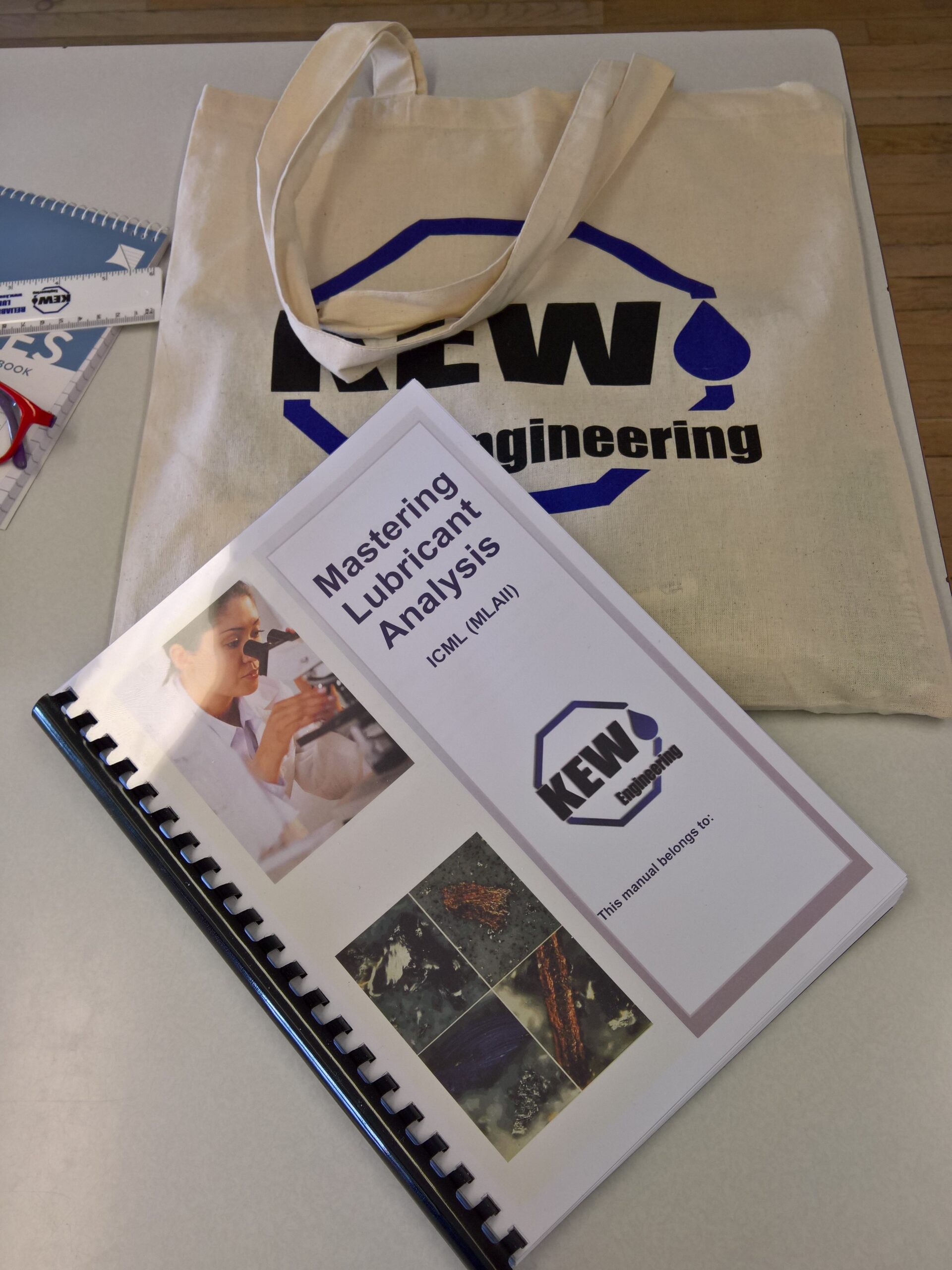
In-person, On-site Courses:
Presented in person at your site or training facilities.
We offer our on-site training globally.
Optional ICML MLA I exam – US$275 per person in the UK. Check the ICML page for other regions.